There was a time when influence in tech looked straightforward: secure headline coverage, put a charismatic CEO on stage, generate buzz, repeat. That model has not disappeared, but it is no longer enough.
Today, attention is easier to win yet harder to keep. Brands can trend for a day and be forgotten by the next news cycle. They can dominate headlines and still be misunderstood. They can be highly visible yet absent from the conversations that matter most.
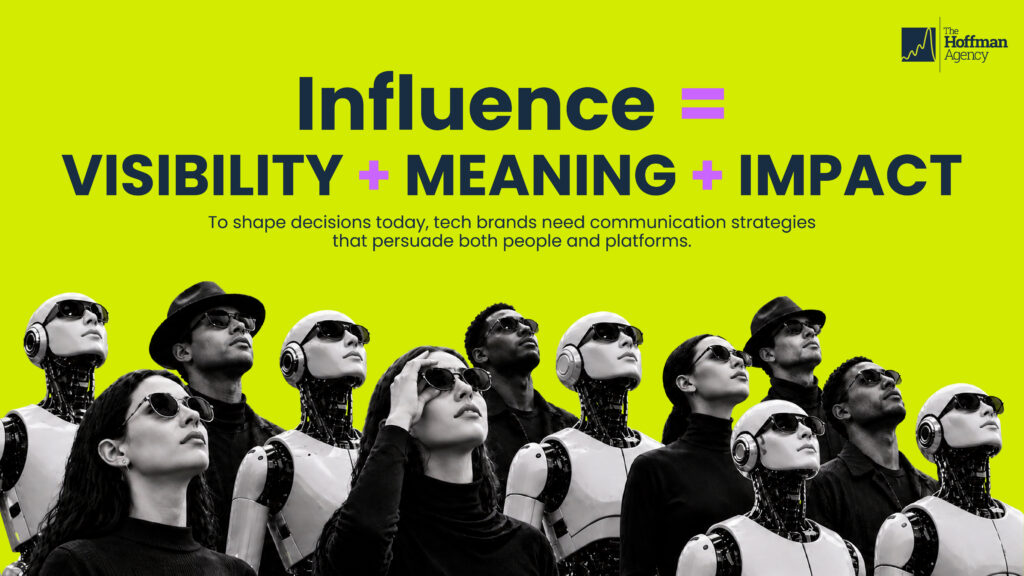
There is now a new equation for influence in technology: Visibility + Meaning + Impact. And increasingly, it must work across both humans and machines, as the latter become new stakeholders in their own right.
Influence today is built through a clear point of view, signals of credibility, and messages strong enough to survive human debate and machine summarisation. Attention is cheap; trust and durability are what count, and are most difficult to earn.
Techfluence is how we define the kind of influence that technology brands now need. It goes beyond awareness or “getting coverage”. It is the ability to be discoverable, memorable, credible and consequential across both human and machine audiences.
When done well, Techfluence supports real business outcomes: stronger valuation confidence, more resilient share price narratives, improved product perception, talent attraction and market share growth. It is a practical lens for understanding how influence is created in a changed environment.
Why the equation has changed
Three shifts around attention, AI and trust are redefining influence for tech brands.
To begin with, attention has fragmented. Audiences no longer gather in one place. Influence is shaped across short-form video, newsletters, podcasts, niche communities, analyst circles, Reddit threads and private group chats. A single high-profile story does not carry the same weight it once did. Brands must show up across multiple surfaces, in different formats, with consistency.
Second, machines are now a legitimate part of the stakeholder map. AI tools and large language models do not replace human audiences, but they increasingly shape how people discover information and how narratives are interpreted. Gartner expects traditional search engine volume to decline 25% by 2026 as users shift toward AI chatbots and virtual agents. That means many first impressions will be formed through summarised answers rather than direct visits to websites or articles. If your story is vague, inconsistent or unsupported, AI systems may compress it into something simplistic or unhelpful.
Third, trust is on shakier ground everywhere. Reuters Institute’s Digital News Report 2025 found trust in news stable at around 40% globally, but still low overall. In this environment, audiences look for credibility cues: proof points, consistency, expertise, third-party validation and leaders who sound informed rather than over-rehearsed.
Taken together, these shifts mean communications now has more moving parts: more surfaces, more engines, more intermediaries and greater importance placed on clear sourcing, consistency and credibility.
Attention vs equity: a reality check
We live in an era where anyone can say almost anything, instantly, to a global audience. Outrage travels fast, exaggerated claims draw clicks, and sharp but often shallow takes outperform nuanced ones. But attention is not the same as influence.
Short-term attention can come from rage-bait, inflated promises or headline-friendly theatrics. It may create spikes in visibility, but little lasting value. Long-term equity is different. It is built through a repeatable point of view, credible signals, evidence, sustained presence and statements that actually shape decisions. That is the difference between being talked about and being trusted.
A useful test for any campaign or executive message might be:
- Will this earn attention?
- Will this build equity?
- What proof makes it believable?
Visibility is now the entry ticket
Visibility still matters, but it should no longer be the goal. Today, many tech brands are highly visible and strategically weak. They are everywhere, yet stand for little. They generate mentions, but not meaning.The brands that win pair visibility with clarity and consequence. They communicate a point of view people can repeat. They change perception. They influence choices made by investors, customers, policymakers and talent.This matters even more in a politically charged and geopolitically complex environment, where narratives move quickly and scrutiny is intense. A brand story can now be reduced to a single label by an AI system or a viral post. If that label is inaccurate, recovery is harder.The new equation remains simple: Influence = Visibility + Meaning + Impact. But in the era of humans and machines, each element must hold up under scrutiny, repetition and compression.
The Techfluence stack
We see five core drivers of influence. You might think of them as the Techfluence Stack, but more than that, they offer a playbook for action.
1. Opinion
Have a clear stance, not corporate wallpaper. Brands with conviction are easier to understand and easier to remember.
2. Reaction speed
Respond quickly when moments matter. Not with noise, but with relevance and context.
3. Soundbites + proof
Ideas need to travel. Soundbites are the unit of modern influence. They are what gets quoted, headlined and repeated. Proof is the guardrail. It is what ensures bold messaging does not collapse under scrutiny.
4. Presence
Be present where influence is formed: earned media, owned channels, communities, analysts, creators and AI discovery environments.
5. Consequence
Do your words or products move anything? Do they shift category narratives, investor confidence, customer preference or policy conversations? If not, visibility alone is not enough.
We have already seen aspects of this playbook in action repeatedly. Steve Jobs turned product launches into cultural moments because vision, language and consequence came together. Satya Nadella reshaped Microsoft’s narrative by pairing visibility with a clear philosophy around culture, cloud and transformation. Jensen Huang has helped make NVIDIA synonymous with the AI era through technical authority, consistency and repeated market-moving moments.
And many brands offer the opposite lesson: strong share of voice, little distinct meaning.
Ultimately, Techfluence is built, not declared. Over the coming months, we will unpack each driver in more detail: how opinion is formed, why soundbites matter, where influence shows up, how narratives travel, and what separates noise from durable market impact. In today’s market, being seen is only the beginning. The real question is whether you shape what happens next.